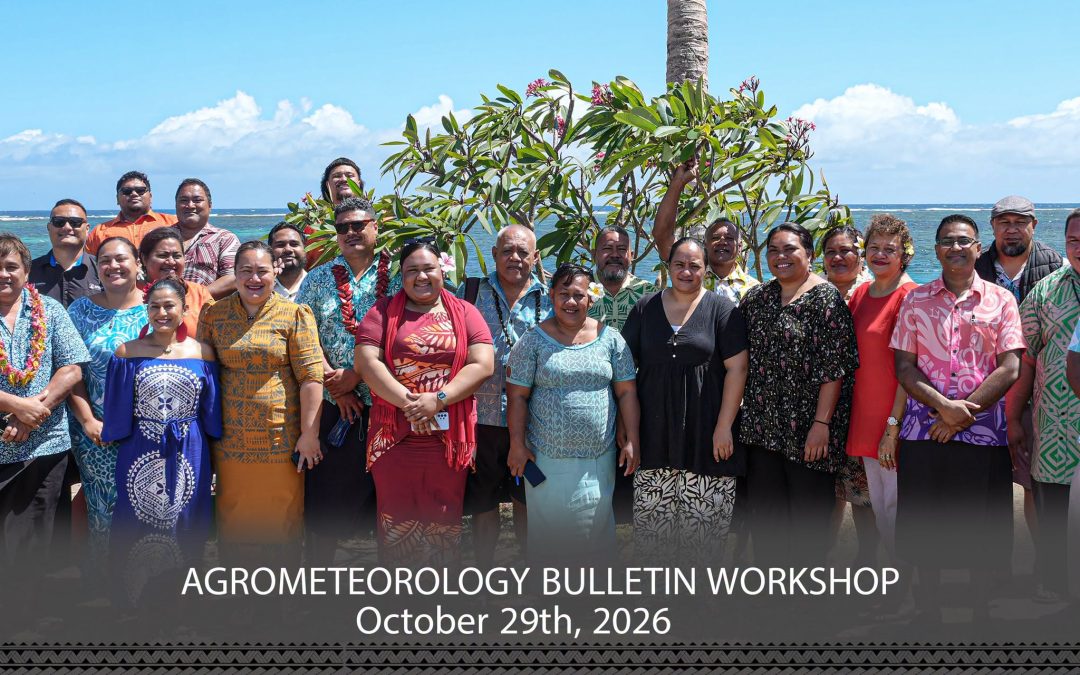
Samoa’s farmers will soon receive crop-specific advice drawn from seasonal climate forecasts, after government agencies, researchers and community partners met in Apia this week to revamp the country’s Agrometeorology (Agromet) Bulletin.
The workshop at Taumeasina Island Resort was led by the Meteorology Division of the Ministry of Natural Resources and Environment (MNRE), in close collaboration with the Ministry of Agriculture and Fisheries – Samoa. Partners included SROS, Live & Learn, the Farmers Societies and Associations, Exporters, FAO and farming communities.
A strong El Niño, expected to persist into early 2027, has already brought bushfires, water shortage and elevated risk of drought-like condition for whole of Samoa. “For Samoa, this brings a real risk of dry spells and drought. Our farmers face hard decisions on when to plant, how to protect crops, manage water and care for livestock,” said Afaese Dr Luteru Tauvale, Assistant Chief Executive Officer (ACEO), which oversees the Samoa Meteorology Division.
Samoa is strengthening the link between seasonal climate information and on-farm decision-making through an upgraded Agrometeorology Bulletin. While the National Climate Outlook Forum (NCOF) issues seasonal outlooks ahead of each wet and dry season, the process of converting forecasts into practical farming advice has traditionally been informal. The new bulletin will provide crop-specific guidance by highlighting climate triggers to monitor and the actions farmers can take in response. Stakeholders also explored a range of communication channels, including social media, the Samoa Met app, radio, and district information boards, to ensure information reaches farming communities effectively. Technical Working Groups will soon be established to help sustain and further develop the bulletin over time.
“Technology and raw data alone do not save crops or protect livelihoods,” said Mr. Salesa Nihmei, SPREP’s Director of Climate Services and Information. “Climate science only delivers true value when it reaches the hands of those making daily economic and operational decisions on the ground.”
One farmer, said “for farmers, having clear and practical climate information means we can prepare rather than react. It helps us protect our crops from pests and diseases, manage water resources more effectively, and take early action as Samoa continues to experience the effects of El Niño.”
A follow-up session is planned for early next year to review the updated Agrometeorology Bulletin, formalize the Technical Working Group (TWG) arrangements, and conduct trial testing of the bulletin with partner organizations working directly with farmers. The session will provide an opportunity to validate the bulletin’s content, assess its practical application in agricultural decision-making, and gather feedback to further refine the product before broader implementation and dissemination.
The initiative is funded by the European Union through the Intra-ACP ClimSA programme and facilitated by the Secretariat of the Pacific Regional Environment Programme – SPREP, which provides technical support in strengthening climate services across the Pacific