

News
Read more in the Public Awareness page
|
Summary of Waste Management Policy
A National Waste Management Policy is now in operation to guide data collection and updating, the development of strategic plans for better waste collection, transportation and disposal of waste, and promotion of awareness through education.
Waste management is covered under the Lands, Surveys, and Environment Act 1989. The enforcement of this Act ensures that polluting impacts of uncontrolled disposal of waste is effective. Improved public awareness of fines has led to obedience from the general public.
The National Waste Management Policy which was approved by Government in September 2001 is in operation and takes account of development initiatives instigated by the private and public sectors. The Government has expanded its municipal solid waste management service to cater for the two main islands of Upolu and Savaii.
The national actions and achievements pertaining to waste management in Samoa are:
- The Ministry of Natural Resources, Environment and Meteorology has begun national initiatives to combat the propagation of hazardous waste chemicals as well as potentially hazardous substances in Samoa. Under its commitment to international agreements controlling the transboundary movement and disposal of hazardous wastes in sites that cannot cater for such, Samoa has put together a National Implementation Plan for the Stockholm Convention on Persistent Organic Pollutants.
- The international Basel Convention on the Transboundary Movement of Hazardous Wastes, and its regional version of the Waigani Convention have been ratified and a national policy has been planned to translate these conventions into the national level.
- New waste landfill sites have been developed using the Fukuoka Method.
- Various onsite small sewerage treatment plants have been constructed with
a major plant to be constructed in 2006-2008.
- A number of demonstration
projects in waste separation have been carried out and have increased public
awareness of waste management.
Projects/Program to be implemented (2006-2007)
1. Industrial waste management project
This project aims in improving the local capacity to deal with handling of industrial waste separately. At present, industrial waste are disposed of together with general household waste at the new landfill site.
2. Large Scrap Metal Recycling
A large scale scrap metal recycling operation will be established at the Tafaigata landfill site. Appropriate and specialized machines and equipment will be imported from Australia to effectively and efficiently implement recycling operations. The main purpose of this project is to effectively eliminate heavy scrap metals from the solid waste stream.
3. Solid Waste collection Project (2006-2011)
This project aims to introduce to Samoa the bins system widely used in many developed nations like New Zealand. Under this project, wheelie bins will be given to all household in Apia, and later in greater Samoa. Households in the Apia area will receive two bins for general waste and recycling waste during the first year of the project. Special rubbish trucks will provide collection services for these bins. Various funding mechanisms will generate sources of revenue to sustainably provide financial support for this project.
Banning of the importation and use of non biodegradable plastic bags
A regulation to ban the importation and use of non biodegradable plastic bags in Samoa with the aim of minimizing the generation of plastic waste in Samoa for environmental and public health protection is effective on the 1st June 2006. Plastic waste materials cannot be degraded naturally like organic waste and thus the disposal of these waste materials is always problematic given their nature. The public is encouraged to use clothing and cotton bags, pandanus baskets, paper bags and others of similar types as alternatives to the banned non biodegradable plastic bags. In order to introduce the biodegradable plastic bags as alternatives, there are prescribed approved specifications of the bags biodegradability. All plastic shopping bags must have 50% starch in their chemical make up, while packing bags must have 30% starch. This ensures that these bags biodegrade within one year for shopping bags, and 2 years for packing bags.
|
Manumea and Maomao School Awareness
Campaign and Community Presentations
The month of July has been an extremely jam pack month for the Manumea Maomao team with the project coming towards a close; the team has been busy conducting the last field surveys, community consultations and school awareness campaign.
Talie Foliga and Joe Reti have been busy entertaining primary school children
both here in Upolu and Savaii, by traveling to specific schools and putting on
lively performances that increase the children’s level of understanding of the
importance of these two rare endemic birds of Samoa. But the program did not
just focus solely on the manumea and maomao it also taught the children about
other native birds of Samoa, their importance to our environment, economy and
way of life; and why we should protect them along with the habitats that they
live in. The program was greatly appreciated by the schools which were visited.
It is the hope that the team will be able to continue doing these school programs
and cover all primary school in Samoa. Along with the school performance the
Maomao squad currently have a radio program running on Talofa FM Saturday mornings
at 9:15am, a questions and answers session with prizes for those give the correct
answers.
Schools visited:
1. Falese’ela Primary School
2. Saleilua Primary School
3. Lalomanu Primary School
4. Ti’avea Primary School
5. Lepa Primary School
6. Tafua Primary School
7. Salelologa Primary School
8. Faala Palauli Primary School
9. Asau Primary School
10. Aopo Primary School
The community consultations were conducted in the evenings between 6pm-8pm. This was led by Toni Tiapama'a and Talie and any two to three members of our team. With the community consultations the group was revisiting villages in which they had conducted field survey's in their forests and conducted community surveys with; as well presenting them with our results. Unlike the school program which was greatly welcomed and appreciated by all schools the team however met with a mixture of those who accepted what the group was doing and those who ·did not even bother to show up at the meeting place or inform the villagers. But all in all, minus the little hiccups the majority of villages were really interested in the findings and what was proposed they could do to protect their forest and birds.
The last field surveys for the project were carried out solely by Talie and Toni.
Unlike other surveys of the past they weren't that successful but the team had
the weather really to blame for that, as it was always raining, which meant no
birds. However, one Saturday morning the team decided to met up and go for a
hike up to "le fale o le fee", and guess what in their very own back yard here
in town the Maagiagi valley is filled with Ma'oma'o birds and in the distance
the team could hear the ever elusive manumea's haunting call. Another critically
endangered bird heard was the Tu'aimeo (Friendly ground dove). The area is a
haven for native birds; the following is a list of the birds identified in the
area.
| Common Name |
Samoan Name |
Scientific Name |
| Pacific pigeon |
Lupe |
Ducula pacifica |
| White-rumped swiftlet |
Pe’ape’a |
Aerodramus spodiopygius |
| Blue crown lorry |
Segavao |
Vini australis |
| Samoan Starling |
Fuia |
Aplonis atrifusca |
| Polynesian Starling |
Miti vao |
Aplonis tabuensis |
| Samoan Fantail |
Se’u |
Rhipidura nebulosa |
| Samoan Broadbill |
Tolaifatu |
Myiagra albiventris |
| Samoan parrot finch |
Manu ai pa’u la’au/ Segaula |
Erythrura cyaneovirens |
| Wattled honey eater |
Iao |
Foulehaio carunculata |
| Cardinal Myzomela |
Segasegamau’u |
Myzomela cardinalis |
| White tailed tropic bird |
Tava’e |
Phaethon lepturus |
| Jungle Mynah |
Maina vao |
Acridotheres fuscus |
| Red vented bulbul |
Manu Palagi |
Pycnonotus cafer |
|
|
Read more in the Public Awareness page
|
UNCCD Public Consultation
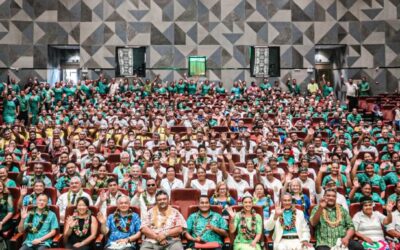
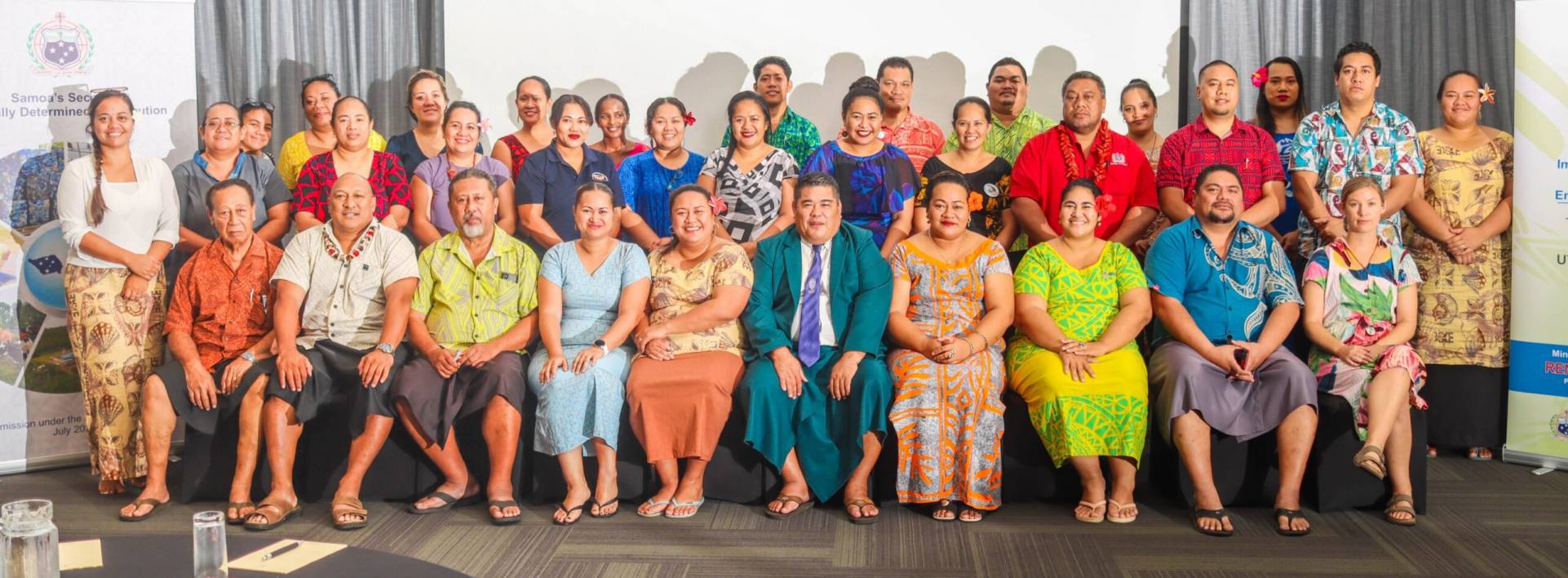
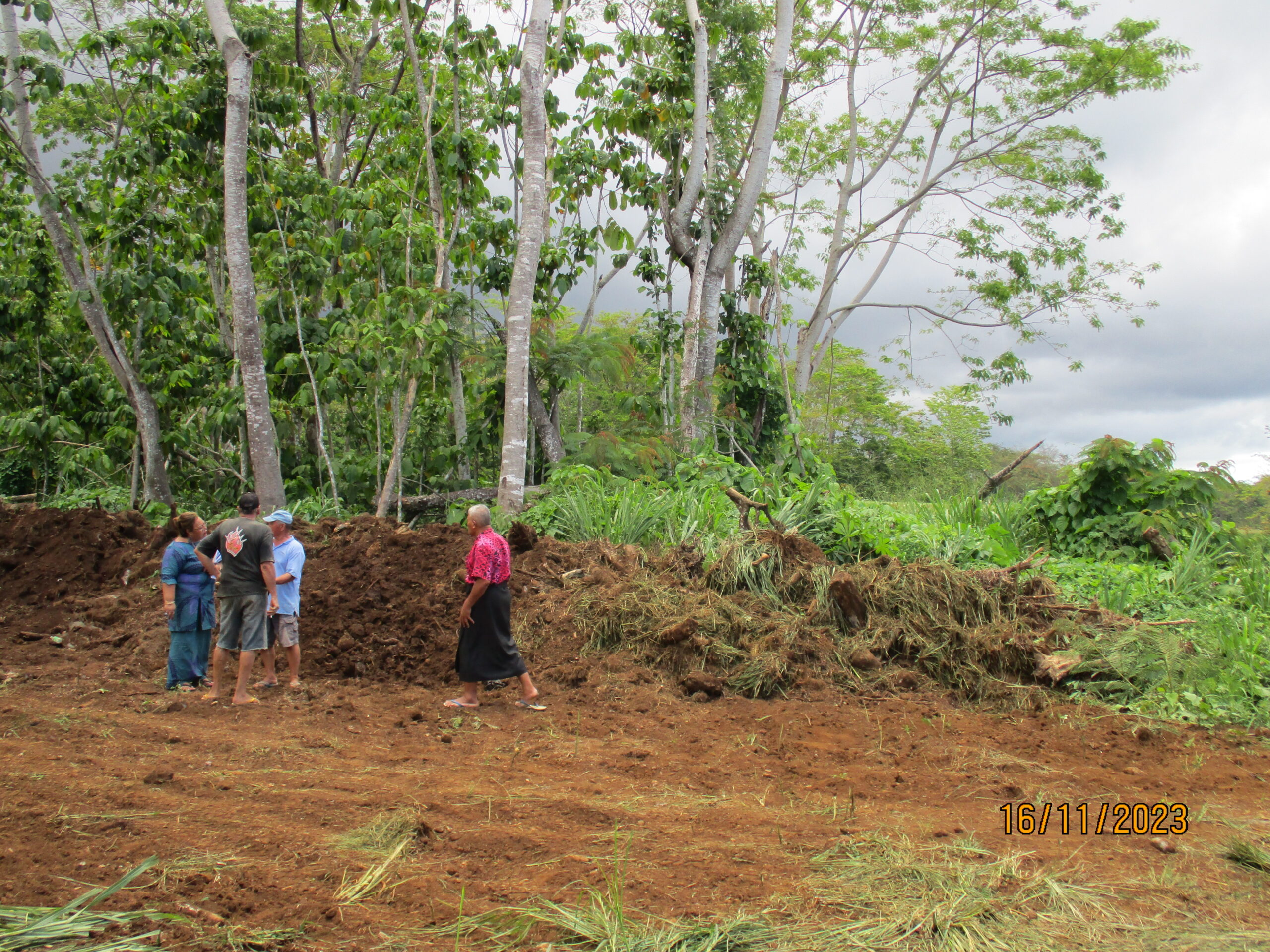
Public consultations of local communities for the formulation of Samoa's National Action Programme(NAP) to combat land degradation were carried out on 17th-18th July in Upolu and 21st-22nd in Savaii. The main purpose of the occasion was to consult with different representatives from villages in the country about the effects and causes of environmental issues on land.
Samoa and its land The potential for Samoa to pursue sustainable development depends upon maintaining the quality of certain, necessarily limited, land-based natural resources. At their most basic, these resources provide essential life-support systems; maintaining water supplies and soil fertility, protecting forests and forest ecosystems including endangered species and terrestrial biodiversity as well as individual islands from coastal erosion. Yet, whilst some traditional practices have been quite sustainable, historically, Samoa has developed a cash economy by liquidating natural capital, a process having its origin in the 'frontier' culture of western economies. As a result, Samoa's natural life-support system has been critically under diminishing process. Even in the few circumstances where it is possible to create substitutes for these systems, the cost is high.
Land, like financial and human capital, is a factor of production, which helps drive economic and social development, generates national income, wealth, jobs, government revenue and local livelihoods as well as subsistence. Land development performed with the ultimate view of attaining sustainability of the land environment, combats poverty, improves the standard of living of all and ultimately entrenches social, ecological and political stability in any country. Land tenure like culture and tradition stands to evolve organically over time in a society. As in all things, changes and solutions have been made and formulated. As such, solutions have to be formulated from within and must reflect national, family and individual needs and aspirations; and changing global, regional, national economic, ecological, social and political dynamics that determine our destiny.
|
|